
Tag: Brenda Sutherland

  • Healthy Mind; The Basis to Change Habits Successfully

    Healthy Mind; The Basis to Change Habits Successfully

    The Healthy Mind Platter is a great foundation to start the year. Get this right and the body and healthy habits will follow.

    New Year’s resolutions are fraught with failure, yet if we look at ourselves holistically then we can begin to develop healthy habits. The healthy mind platter developed David Rock and Dan Seigel gives a fundamental framework to develop rituals that are sustainable.

    “The Healthy Mind Platter has seven essential mental activities necessary for optimum mental health in daily life. These seven daily activities make up the full set of ‘mental nutrients’ that your brain needs to function at it’s best. By engaging every day in each of these servings, you enable your brain to coordinate and balance its activities, which strengthens your brain’s internal connections and your connections with other people.“

    Elements of the Platter

    The seven essential daily mental activities are:

    1. Connecting Time: When we connect with other people, ideally in person, or take time to appreciate our connection to the natural world around us, richly activating the brain’s relational circuitry.
    2. Physical Time: When we move our bodies, aerobically if possible, which strengthens the brain in many ways.
    3. Time In: When we quietly reflect internally, focusing on sensations, images, feelings and thoughts, helping to better integrate the brain.
    4. Play Time: When we allow ourselves to be spontaneous or creative, playfully enjoying novel experiences, which helps make new connections in the brain.
    5. Focus Time: When we closely focus on tasks in a goal-oriented way, taking on challenges that make deep connections in the brain.
    6. Down Time: When we are non-focused, without any specific goal, and let our mind wander or simply relax, which helps our brain recharge.
    7. Sleep Time: When we give the brain the rest it needs to consolidate learning and recover from the experiences of the day.

    Your Healthy Mind Platter Exercise

    1. Outline the elements of the healthy mind platter and needs
    2. Brainstorm ideas for each element, allowing the ideas to simply flow without analysing. Write them down.
    3. Evaluate Solutions that meet your needs
    4. Choose solutions and times of the day that are most suitable for you to do this
    5. Implement Solutions
    6. Celebrate Your Victories after every solution implemented. Remember you are changing the brain, and body – so take time to celebrate your awesomeness. Here’s a few ideas: https://www.wellthyboss.com/tiny-habits-w-bj-fogg-linda-fogg-phillips/
    7. Check Results weekly – make a time each week to check in and evaluate whether the solutions need to be updated
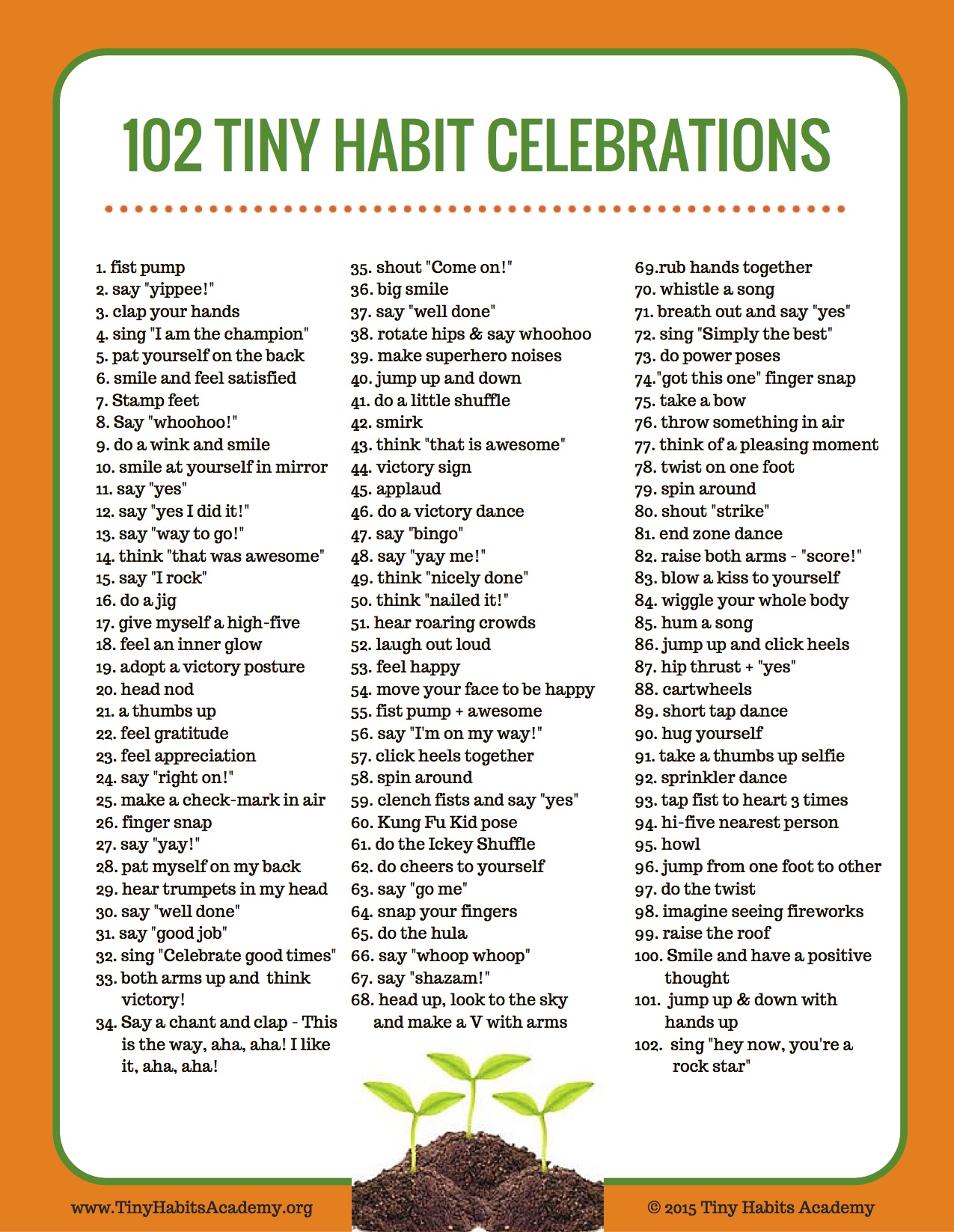
    102 Tiny Habit Celebrations

    Start with Tiny Habits

    We are bound to fail if we set our goals too high too fast without clear ideas how to support the habits changing and reinforcing the changes. We may have the motivation to start with but not the ability to do it or the trigger to develop the habit.

    BJ Fogg outlines 15 ways to change behaviour over a long term period https://www.behaviorgrid.org So of these ideas are:

    Fogg Behavior Grid (with examples)
    1. Modify your environment: includes your social, work environment
    2. Make the habit small to start with so that training your body brain to make a habit automatic
    3. Design not for the outcomes but the behaviour that leads to the outcome, therefore the healthy mind platter is a start to assist this. For instance weight loss there are many behaviours the contribute to the outcome ie stress reduction, eating habits, etc. Creating tiny habits change the end outcome.
    4. Three things that need to happen to create behaviour change – High Levels of Motivation, ability to do it, Trigger (call to action). These three things together create change.

    Develop your Own Format

    Including Motivation, Ability and Trigger to develop a new habit you may want to try this:

    “After I (existing habit – trigger)………., I will (new tiny behaviour)…………”

    Following on from a habit you already have then add a new behaviour.

    Tiny habits might be: “After morning coffee I tidy something in the house”. “Every time I walk in the door I will hug my partner”. “I will walk to work from the previous train station”

    Remember to celebrate, find one that works for you, after every behaviour that you have changed. The more you do it the more you automate the behaviour.

    Combining the Healthy Mind Platter enables you to look at your life, look at what you want to change, break it down into tiny behaviours and put it into right spots in your day combining triggers to remind you, and the behaviour will naturally grow.

    Sharing Success

    To support those tiny habits changing we would love to hear how you have gone, how you celebrate the little changes and your awesomeness. Add comments below……

    _________________________________________________

    References

    Seigel, D & Rock, David., The Healthy Mind Platter https://psychologyonhay.com.au/wp-content/uploads/2020/04/POHHealthyMindPlatter.pdf

    Fogg, B. J. (2012) ‘Forget Big Change, Start with a Tiny Habit’ TedXFremont YouTube https://www.youtube.com/watch?v=AdKUJxjn-R8

    Fogg, B.J. ‘Tiny Habits’ https://www.blinkist.com/en/books/tiny-habits-en#:~:text=Brief%20summary,blueprint%20for%20sustainable%20behavior%20change.

    Fogg, BJ. ’15 Ways Behaviour Can Change’ https://youtu.be/Sd7xx1n3dl8?si=gCEHnjRZzBTx6W3A

    Fogg, B.J. & Fogg, Linda ‘Celebrating tiny Habits’ https://www.wellthyboss.com/tiny-habits-w-bj-fogg-linda-fogg-phillips/

  • Connection Rituals – Keeping the Juiciness Alive in Relationships

    Connection Rituals – Keeping the Juiciness Alive in Relationships

    One of the questions asked in couple therapy is what connection rituals do you have? Keeping the juiciness of intimacy alive is paramount in sustaining couples in their challenging and stressful, worlds. 

    Maintaining a secure functioning relationship means taking care of the relationship with the understanding that ‘love is a verb’, as Esther Perel would say.

    The avoidant-anxiously attached partner would normally run at the idea of ritual, as they often feel trapped and swamped by commitment, yet connection rituals free up time for more alone time. Rituals reduce the amount of avoidant’s deactivating strategies such as focusing on small imperfections, flirting with others, pulling away when things are going good, checking out mentally and avoiding physical closeness.

    For the ambivalent-anxiously attached partner these rituals reduce protest behaviours such as excessive attempts to re-establish contact, punishing by withdrawing, keeping score, acting hostile, threatening to leave, manipulation and making the other feel jealous. These connection rituals soothe their fear of abandonment, relieving their nervous system to then allow more space in their life and their partners life. 

    Rituals are supportive for both partners nervous systems and essential in keeping the relationship connection alive and juicy.

    THE BASICS

    These little daily rituals create a big difference in relationships. We often create conflict due to the way we move towards and away from each other, it’s not personal, we are simply wired to each other for our survival. If partners do not manage these movements they start fighting due to the ruptures created and the need for connection or space.

    1. Launching the Day – What is one thing that you can do that creates that juicy connection with each other at the start of each day? For example: eye gazing in bed, coffee on the deck, a shower together, a morning walk, making love. Negotiate and agree upon a ritual that you both commit to every morning. As an avoidant I often feel like squirming out of this one as I like to go running or swimming early in the morning, disappearing into my own space, but I pay the price in my relationship if I do. I miss the juicy connectedness that energizes me for the day. So if you have an avoidant partner give them an escape route ie; “I don’t want to stop you from your day, you just need to give me a hug before you go”
    • Welcome Home Hug – Our worlds are busy, there are a lot of issues to deal with throughout the day, decisions we have to make and pressures put on us creating stress. Calling upon each other to recalibrate ourselves from the demands of the day ensures we do not bring the stresses into the house and emotionally indulge in trying to get the feelings out. So the first thing on arriving home is to seek the other out and give each other a ‘Welcome Home Hug’. This is a hug where you don’t let go until the other is completely relaxed. One way of doing this is to relax your own nervous system and the other begins to relax (in this way we are using mirror neurons to recalibrate each other’s nervous system). “If In Doubt Hug it Out”
    • Landing the Day Together – Soothing each other’s nervous system in the evening can include putting each other to bed, watching a movie together, walking in the evening, reading together, discussing your day. If you are parents with children, allocate a space in the house that when you are seated there you are not to be disturbed, unless it is very urgent! Discuss and negotiate this ritual with each other as it has to work for both. Also note that going to bed at the same time together means that you regulate each other’s nervous system so the one that usually is a night owl often finds they sleep better.

    The key in establishing these rituals is the commitment by both of you in the relationship. If there is a mutual agreement then both are responsible for upholding it. If there is no agreement come back to the drawing board and find what works for you both. If one partner is not interested, you have a problem in the relationship being tipped towards ‘pro-self’ rather than ‘pro-team’. 

    Secure functioning relationships are based on mutuality, fairness, justice and sensitivity. 

    The motivation is that secure functioning relationships allow you both to be better in the world, achieve more, hold more, play more and work effectively as a team whist protecting each other in public and in private. Isn’t that the reason you are in a relationship? Remember, this is a ‘We’ gig not a ‘Me’ gig.

    THE JUICE

    Giving time for weekly rituals sustains your relationship so it sustains you, despite what an avoidantly attached partner thinks. It frees up resources to be able to be better in the world and with each other.

    Ideas for rituals throughout the week could be

    • Eye gazing (Soul gazing)– We all want to be seen, to feel as though we matter and thrive on secure connection. “I see YOU, you have my full attention” is portrayed in taking the time to really look at each other and breathe each other in. 
    • Random acts of affection – Long passionate kisses, flirting etc in private or public – check whether your partner is comfortable with signs of affection in public. This can be done whilst passing in the hall, or coming out of an office into the house and family.
    • Shared Hobbies – what do you love doing together? Make time for this on a weekly basis.
    • Plan for quality time over quantity – Saying when you need ME time/space or more connection. Negotiate connection and space from each other. Remember behaviour is propelled by needs. Therefore ask when there is a need for more connection or space rather than fighting for it.   
    • Making a meal and enjoying it together, switching off phones and screens just enjoying each other’s company.
    • Cuddling in bed – Even when tired, making the effort to physically connect and hold each other. 
    • Radical Honesty – Energy is wasted by not being truthful. Relationship WE checkups. Not to be done in bed, find a space to do this and meet once a week. A question to ask is: How can I be better in our relationship? What have you loved me doing, or being this week?
    • Exercise Together – What do you both like doing together? Create something and do it regularly. Examples are biking walks, kayaking, swimming followed by a meal a few times a week.
    • Dates – whether it is for coffee, breakfast or dinner or pleasure pauses throughout your work day, make time for novel experiences throughout your week. It amplifies your connection and creates great stories
    • Games – there are a number of couple adventure or bedroom games. Add laughter and adventure into your relationship.

    One of the myths we have is the difference between co-dependency and interdependency. Interdependency does not sacrifice an individuals needs. Rituals give us the inspiration, love and energy to be better in the world as it shores up resources. 

    FESTIVE SEASON RITUALS

    • Watch each other’s favourite seasonal movies or shows 
    • Prepare a themed meal and enjoy it together, distraction free 
    • Take a walk around your neighbourhood and admire the Christmas lights and different stress decorations 
    • Find a local volunteer opportunity to start together or contribute to over the festive season
    • Start a two-person book club and read a book together 
    • Share what you’re thankful for with your loved ones 
    • Create your own festive season tradition!

    A FEW STEPS

    How are you going to revitalise, nurture and keep your connection alive over the new year?

    Make time to discuss what connection rituals work for you both.

    Set them up and trial it for a week and then review at the week what works and what doesn’t and alter accordingly.

    Keep creating rituals that take care of the relationship and the “WE” gig.

  • Family Constellations: Combining Sensorimotor Art Therapy (Online)

    Family Constellations: Combining Sensorimotor Art Therapy (Online)

    Experience Family Constellations using various props, drawing, plasticine to move in tune with your ancestors.

    Often we find ourselves reacting in ways that despite all the counselling we can not change. These behaviours act as a symptom pointing to what needs to be seen and acknowledged in our ancestry. Once seen we can live our lives with a sense of freedom and support from our ancestors

    Family Constellations works with Systemic principles and it is not the form that constellations take but the principles that govern systems.


    For more information see link. https://student.awakening.com.au/course/family-systemic-constellations/