“To be nobody-but-yourself — in a world which is doing its best, night and day, to make you everybody else — means to fight the hardest battle which any human being can fight.” E. E. Cummings
As life tumbles us with a myriad of experiences of which we adjust, try to digest and survive, whilst endeavouring to thrive, a very subtle shift happens. We leave energetically. We stop taking our place, as fully ourselves, right in this moment. I don’t mean intellectually, although we do tend to be in the past or future in our thoughts, but energetically.
There is no other you. There is no other you having your experiences. There is no other who was born to be you, as you are. Sure there are other people with similar experiences, but there is no other you.
Taking your place means, right now in this moment taking your place fully, in life, as it is. It takes a fierce presence with what is, not to move from it, or argue with yourself that you could or should be different, it just is. Right now means taking your place in the fierceness of life, right in this moment. There is no other moment.
“Shame has this whole effect on people – they want to disappear – they don’t want to be here”. Dr Stephan Porges
As feelings arise, simply take your place and let feelings come and go, they will not move you if this is fully embraced, owned and embodied.
One could ask “what would it take for you to fully take your place right here and right now”, although that is not even needed as we move from intellectualising to energetically being present!
So the invite is to take your place in your life, (no one can do this for you) right here and right now, fully as an embodied experience. Fully from the tips of your toes, to the top of your head, tips of your fingers to the tip of your nose. No one else has this life, yet you are never alone.
Take your place in this moment is your birthright. Running away just makes one prone to the experience of being a pebble on the foreshore. Take your place and don’t move from here energetically, then see what happens to the feelings, thoughts and sensations. When they come, you do not have to work them out, or fix them, or resist them, simply welcome them, as you sit in that fierce compassion for self. Directly experience them, they will then burn up in you, along with the memory that created them. Taking your place, in this moment, is an act of the deepest compassion and full embrace of who you are.
“I want you to listen to me”, “I want you to stop talking to me like that”….sound familiar? Add your own request here that you often request.
Sam and Liz are both trying to prioritise their relationship goals. So Sam suggests they go camping more often, whilst Liz loves the theatre, neither agree on the solution as neither like the others idea. Yet each others needs have not been identified, only solutions to meet their needs. This is where conflict usually starts because both are trying to get a need met yet having identified it to them self and then each other. So now we have a conflict of solutions which leads to disappointment, frustration and disconnection in the relationship.
This is an all too familiar scenario nowadays, one that affects the way we connect and expect from each other. Fundamentally we are each trying to be understood, heard, and connect as well as feel as though we matter. Our disjointed communication is also filtered through our negative bias in the brain that is geared for war, thus often resulting in misunderstandings causing conflicts.
The usual scenario is that communication, requests start with being solution focused rather than needs focused, resulting in conflict of solutions without really knowing the need that is trying to be satisfied. Solutions are simply ways of attempting to get a need met.
“Communication is to relationships what breath is to life” Virginia Satir
Most of us do not know what need is trying to be met, so we come up with solutions for ourselves, or others without actually understanding the real motivation.
Now if Sam and Liz started with their needs then solutions would simply flow out of this understanding. SoWhat can be defined as a need? Abraham Maslow highlighted the basic hierarchy of needs in the 1940s, Max Neef expanded on these even further taking into consideration changes in social structure over time.
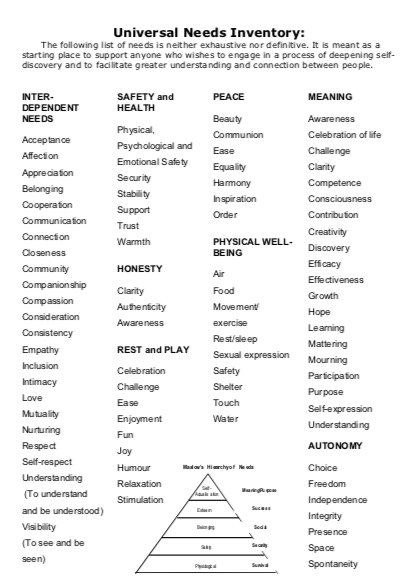
Needs can be grouped into 8 basic categories:
Interdependent needs
Safety and Security
Peace
Meaning
Rest and Play
Honesty
Physical Wellbeing
Autonomy
These categories were then further fleshed out. For example Autonomy further includes Choice, Freedom, Independence, Integrity, Presence, Space and Spontaneity.
So let’s start with finding one of your needs that did not get met. Think of a situation where you did not get your need met. What were the feelings that arose due to not getting the need met? What were the consequences of not getting that need met? How did this change the relationship with the other? Write them down.
Now think of a time where you did get your needs met. What were the feelings that arose due to getting the need met? What were the consequences of getting that need met? How did this change the relationship with the other? Write them down.
Now take a moment and ask yourself in both situations what were the needs trying to get met? Scan the list above to find one that resonates for you per situation. Now in that instance, now that I know the need, how could I have begun to give myself that need? How could I have communicated it to another? How could I have taken care of that need?
Take Two
Let’s come back to Sam and Liz as they begin to prioritise their relationship goals. What if they highlighted their respective needs first. ie Sam really wants to ensure that she matters (need) to Liz. Liz wants to feel as though she has autonomy (need) in the relationship with Sam. By understanding and shoring up their needs first they can brainstorm solutions together that work for both. Sam isn’t really into the theatre but loves going to the movies and of course the outdoors. Liz loves wining, dining and the theatre. So Sam and Liz decided that Liz would go with her friends to the theatre (autonomy needs being met) and that the both of them would have a picnic outdoors once a week just the two of them (the need to matter to the other being met). So both needs are met and there is no conflict of solutions.
Try it
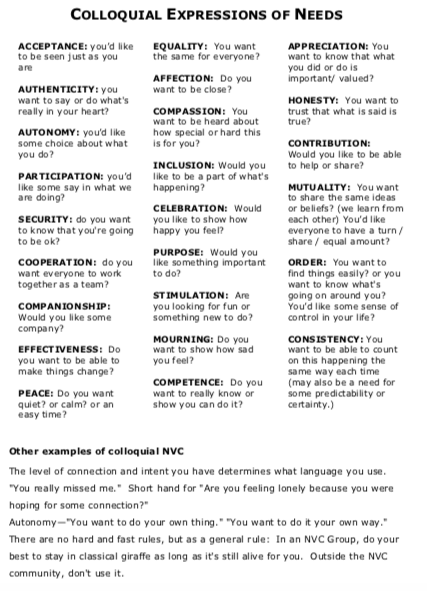
Listening and feeding back the need to check if you have understood it correctly is the key first, whilst beginning to communicate your own. There is room for everyones needs here. Start with yourself first, as often we don’t even realise that we have needs that are trying to be met. Be honest with yourself. When you have a situation arise find out what need is trying to be met. Use the checklist above, the begin to communicate this first or in response to another.
When feeding back what the other is saying try by listening for the need and then check if have grasped it correctly. Here’s how:
“Is it that you value (insert specific need)?”
Or “It sounds like (insert specific need) is really important to you?”
Now listen for the response and alter the statement based on what the person feeds back and try again. There is room for everyones needs here, so don’t forget to add your own. For example try:
“I really value (insert specific need)”
“What is really important to me is (insert specific need)”
Then add:
“Would you be willing to consider coming up with solutions that work for both of us in this situation?”
Now you are onto something.
Listen for the need, consider and include each others needs. Remember this is a win/win gig.
Brainstorm solutions (don’t dismiss any) and then
Mutually agree on a solution that works for both parties (if one compromises unfortunately there is often pay back)
Implement the solution – decide when, how and where and when you will check in again to hear how it is working for the other
Check results – did that work or do we need to refine our solution?
Remember to remain curious about your needs and the others.
By Brenda Sutherland (Founding Director of The Awakening Group)
Relationships are like breathing – inhaling and exhaling, closeness and disconnected, receiving and giving, connection and autonomy.
“We must be open enough to receive each other” Terry Real
Often in couple counselling I witness couples who have simply lost touch with how to receive the other, how to connect and share themselves on these levels:
physically – we don’t even say good morning any more or hug. We used to exercise together everyday.
emotionally – we just don’t talk about the intimate stuff, our needs or feelings anymore, its all about the kids
sexually – the erotic pleasure has died and no one initiates sex anymore. If I do I feel like I am going to get rejected
intellectually – we don’t share our thoughts or our ambitions, concerns, questions, experiences or insights we literally do our own thing nowadays
spiritually – we used to connect in a way that it felt like a spiritual experience, now we can’t even look at each other.
Sound familiar? Our brains are geared up to automate our life so that it is easier to survive, that means we automate each other too! Tricky if you want to ensure the spark remains. It means being mindful of your relationship, taking responsibility for what you bring into the relationship daily, how you receive the other and what opportunities you take to initiate closeness.
Getting Started
A couple of things you might want to look at first.
How do I receive my partner? How do I listen to him/her? Do I really hear what they are saying, their feelings and needs?
How do they know I am listening and receive them?
How do I listen to my feelings and needs so I can communicate them clearly?
How do I offer myself, am I under sharing (withholding maybe because I assume they won’t hear or be rejected) or oversharing (because I feel they will reject me?)
What is one thing I can commit to doing differently?
How can I approach my partner to invite this as a new possibility in relationship?
So heres the deal: We automate each other, so we assume a lot of stuff about the other, which means we alter the way we approach our partner stopping ourselves from asking and negotiating. Then the passion dies! But it is still there, it just needs work.
Giving Up the Defenses
Interested in bringing the spark back into your relationship?
In the age of cultivating mutually agreed upon Couple Bubbles where our relationships are safe havens we have to both take care of each other and the relationship. The connection, intimacy, discussions, and emotional wellbeing of a relationship is a two person job. That means you!
So to help make it work we have to give up a few things:
Wanting to win or be right all the time – both lose!
Controlling your partner to get what you want – they will just disappear into themselves and the passion dies, there will be a pay back!
Revenge if it doesn’t go the way that you want – do you really get your needs met or is this just a tantrum because you don’t want to fess up to them?
Oversharing self expression – what is it that you are covering? Whilst ranting are you really connected or is it a way of avoiding true intimacy?
Withholding or withdrawing (under sharing) – when you withdraw you are not trusted and come across as hiding something. What would it take to put your best foot forward and say it how it is?
So now that you are aware of some of the strategies you “may” have employed to get your needs met without really discussing them we can take the next step.
Get Clear
What do you really want in your relationship? What are you prepared to offer to improve it today? Often we wait for the other to get us, hear us, respect us but in the waiting we are simply avoiding and the gap grows bigger, and the resentment more apparent.
Renew your vision together. Often over time the reason we came together changes. We do those projects, raise the kids and then we need to revision the next phase of our relationship….What fun! Remember this is two person system – Together we revision.
Lets Play!
Remember you are in a relationship, so this is a joint project. Lets start small.
Coming back to each component in your relationship. If one area is fully satisfied then the relationship can withstand, for a time, other areas where it maybe lacking.
Physically – connection rituals help us feel secure, intimate, that we matter and are loved!
Start with a ritual to connect you both as you launch the day. It doesn’t have to be big (a cuddle before you hop out of bed, coffee together in the morning, breakfast together, a morning walk) but do it daily. Both ensure it happens.
Then add a landing ritual – how do you land the day together? Do you go to bed together or does someone full asleep on the couch? Do you read to each other? Do you tell each other about your day? Connect over dinner? Create that landing ritual together.
Welcome home hug – Ok this is not one of those “Hi darling and a peck on the cheer gigs” it is an real tender embrace whereby holding each other until you are both totally relaxed (yep more than 5 secs) – Why? Then you don’t bring all that stress from the day home and you feel instantly connected with each other – Win/Win right?!
Emotionally – Make a time each week to share your needs, feelings, withholds (remember does that thing that happened 5 years ago really have to be brought up weekly? Drop it) so as a couple we can take care of them together. We really don’t know how it is for the other unless we share. Be Bold, its worth it.
Sexually – Take the quiz! Do you know your partners turn ons and offs? You will be pleasantly surprised to discover and recover them by simply asking. Maybe they don’t know – so take Emily Nagoski’s quiz and share.
Organise date nights – yep you would be surprised how many couples never take each other out on dates! Do you think it is time?
Intellectually – Share your day, your thoughts, your ideas, dilemmas, feelings and needs – so you get to know each other again. Saves assuming!
Mutually amplified positives – that sunset, that ice cream, and Oh My that standing in the rain naked – rope the other in too.
Share novel experiences – what are those adventures that you have put on the back burner and the too hard basket – share them
Create new memories by doing one thing different every week
Remember you are each others best friend. You chose the other to share your life with so lets do it.
Spiritually – bring your partner close,
tell them what you love about them,
describe what you see in their face
eye gaze
meditate together
And above all play! Adults forget to have those pillow fights, feed each other, hop into the shower together, surprise each other with a spontaneous adventure. Remember it is Christmas – be your partners gift!
by Brenda Sutherland B. Soc. Sc. (Psych) Founder and Direct and Couples Counsellor at The Awakening Group Pty Ltd