Tag: Brenda Sutherland

  • The Authentic Communicator: 10 Part Program (2027)

    The Authentic Communicator: 10 Part Program (2027)

    Advanced communication skills to strengthen all relationships whilst enhancing each person’s self esteem and connectedness. These emotional intelligent techniques are designed to be used in workplaces, as a parent, teacher, with a partner etc to enhance all relationships.

    10 part Series, 30 hours of advanced communication skills training including:

    Fundamental skills to enhance your personal and professional effectiveness.

    • Active & Empathic Listening
    • Listening for Needs
    • I Messages: Declarative, Responsive, Confrontative, Preventative
    • Problem Solving using Method III
    • No Lose Method of Conflict Resolution
    • 12 Roadblocks to Communication
    • Consulting Skills
    • Conflict Resolution
    • Assertiveness skills and role playing
    • Leadership skills
    • Dealing with Different personalities
    • Values Collisions and how to address them
    • Getting Your Point Across
    • Enhance and Increase Personal Effectiveness

    Want More?

    • Discover why both passive and aggressive behaviour invites intimidation.
    • Learn how to deal with aggressive people.
    • Find out how to stand up for yourself, , and enhance your credibility.
    • Manage situations better with people who are “difficult to get on with”.
    • Avoid unnecessary aggravations and gain more support and cooperation.
    • Attain new levels of self responsibility.
    • Others gain confidence in you when you communicate openly and directly.
    • Learn how to clean up your mistakes in a way that enhances and strengthens your relationships.

    Starts:

    22 September 2026 Tuesday 6.30pm – 9.30pm  (10 part series, 30 hours)

  • There is Never a Conflict of Needs, Only Conflict of Solutions!

    There is Never a Conflict of Needs, Only Conflict of Solutions!

    “I want you to listen to me”, “I want you to stop talking to me like that”….sound familiar? Add your own request here that you often request.

    Sam and Liz are both trying to prioritise their relationship goals. So Sam suggests they go camping more often, whilst Liz loves the theatre, neither agree on the solution as neither like the others idea. Yet each others needs have not been identified, only solutions to meet their needs. This is where conflict usually starts because both are trying to get a need met yet having identified it to them self and then each other. So now we have a conflict of solutions which leads to disappointment, frustration and disconnection in the relationship.

    This is an all too familiar scenario nowadays, one that affects the way we connect and expect from each other. Fundamentally we are each trying to be understood, heard, and connect as well as  feel as though we matter. Our disjointed communication is also filtered through our negative bias in the brain that is geared for war, thus often resulting in misunderstandings causing conflicts.

    The usual scenario is that communication, requests start with being solution focused rather than needs focused, resulting in conflict of solutions without really knowing the need that is trying to be satisfied. Solutions are simply ways of attempting to get a need met.

     “Communication is to relationships what breath is to life” Virginia Satir

    Most of us do not know what need is trying to be met, so we come up with solutions for ourselves, or others without actually understanding the real motivation.

    Now if Sam and Liz started with their needs then solutions would simply flow out of this understanding. SoWhat can be defined as a need? Abraham Maslow highlighted the basic hierarchy of needs in the 1940s, Max Neef expanded on these even further taking into consideration changes in social structure over time.

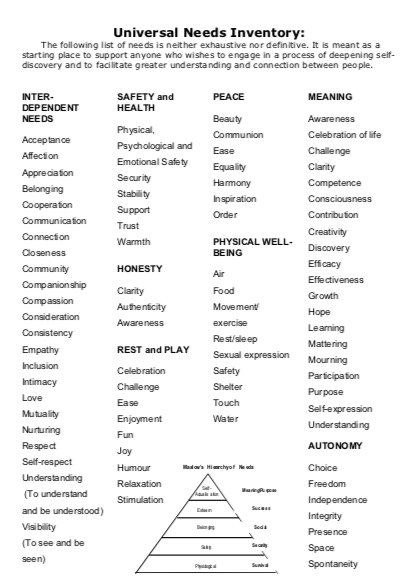
    Needs can be grouped into 8 basic categories:

    • Interdependent needs
    • Safety and Security
    • Peace
    • Meaning
    • Rest and Play
    • Honesty
    • Physical Wellbeing
    • Autonomy

    These categories were then further fleshed out. For example Autonomy further includes Choice, Freedom, Independence, Integrity, Presence, Space and Spontaneity.

    https://awakening-com.s3.ap-southeast-2.amazonaws.com/2019/01/rcrmuwAn-Needs-Inventory.pdf

    Self Check

    So let’s start with finding one of your needs that did not get met. Think of a situation where you did not get your need met. What were the feelings that arose due to not getting the need met? What were the consequences of not getting that need met? How did this change the relationship with the other? Write them down.

    Now think of a time where you did get your needs met. What were the feelings that arose due to getting the need met? What were the consequences of getting that need met? How did this change the relationship with the other? Write them down.

    Now take a moment and ask yourself in both situations what were the needs trying to get met? Scan the list above to find one that resonates for you per situation. Now in that instance, now that I know the need, how could I have begun to give myself that need? How could I have communicated it to another? How could I have taken care of that need?

    Take Two

    Let’s come back to Sam and Liz as they begin to prioritise their relationship goals. What if they highlighted their respective needs first. ie Sam really wants to ensure that she matters (need) to Liz. Liz wants to feel as though she has autonomy (need) in the relationship with Sam. By understanding and shoring up their needs first they can brainstorm solutions together that work for both. Sam isn’t really into the theatre but loves going to the movies and of course the outdoors. Liz loves wining, dining and the theatre. So Sam and Liz decided that Liz would go with her friends to the theatre (autonomy needs being met) and that the both of them would have a picnic outdoors once a week just the two of them (the need to matter to the other being met). So both needs are met and there is no conflict of solutions.

    Try it

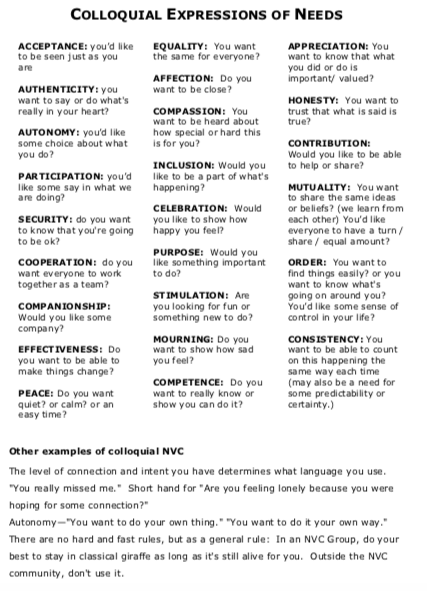
    Listening and feeding back the need to check if you have understood it correctly is the key first, whilst beginning to communicate your own. There is room for everyones needs here. Start with yourself first, as often we don’t even realise that we have needs that are trying to be met. Be honest with yourself. When you have a situation arise find out what need is trying to be met. Use the checklist above, the begin to communicate this first or in response to another.

    When feeding back what the other is saying try by listening for the need and then check if  have grasped it correctly. Here’s how:

    • “Is it that you value (insert specific need)?”
    • Or “It sounds like (insert specific need) is really important to you?”

    Now listen for the response and alter the statement based on what the person feeds back and try again. There is room for everyones needs here, so don’t forget to add your own. For example try:

    • “I really value (insert specific need)”
    • “What is really important to me is (insert specific need)”

    Then add:

    • “Would you be willing to consider coming up with solutions that work for both of us in this situation?”

    Now you are onto something.

    1. Listen for the need, consider and include each others needs. Remember this is a win/win gig.
    2. Brainstorm solutions (don’t dismiss any) and then
    3. Mutually agree on a solution that works for both parties (if one compromises unfortunately there is often pay back)
    4. Implement the solution – decide when, how and where and when you will check in again to hear how it is working for the other
    5. Check results – did that work or do we need to refine our solution?

    Remember to remain curious about your needs and the others.

    By Brenda Sutherland (Founding Director of The Awakening Group)

    For more information and further advanced communication training join us for our online communication training based on the Dr Thomas Gordon model. https://student.awakening.com.au/course/effective-communication-training-online/

  • I’ll do it for you, even if it costs me my happiness

    I’ll do it for you, even if it costs me my happiness

    An insight into Family Constellations 

    Maria was distraught. For two weeks now she had been having panic attacks and didn’t know why. She was desperate for them to stop, as they were worsening. This was the reason she had found her way to counselling. Two weeks prior her partner of five years had asked her to marry him and she had said ‘yes’ and with such excitement she told her family he had proposed. The next day though she found herself getting extremely anxious, doubting whether he would be a good husband or father, not trusting his ability, questioning who she had been living with over the last five years. As the days went by her anxiety grew, until she found herself experiencing full-blown panic attacks. What had happened?

    Maria’s panic attacks are not unlike many symptoms that appear that are connected to the family lineage, as we are part of the family soul.

    What is the Family Soul?

    We all are connected to a family system or soul that reaches many generations past. We are limited by this history as well as strengthened by our ancestors. A family system is governed by:

    • the need to belong; those who are born into a family (whether survived or thrived), brought into a family through marriage, or who have taken a life from this family, in other words, ‘those who belong’, belong. If anyone is excluded they will be represented by a family member. This is often seen in children of divorced parents, whereby a parent has been criticized by the other, out of hidden loyalty the child will side with the parent excluded and criticized. We are only at peace when everyone is included.

    • the need for social order; This ensures everyone is given their rightful place. In a literal sense, this means those who come first, come first. For example, partners take precedence before children unless in a blended family then each others children come before the new partner. We are born into a special place in our family, that is the first born’s place is before the next child and so on. If out of place, a child will feel burdened, be treated as a parent, or may take the place of a lost child or previous partner resulting in strange dynamics.

    • the need for equilibrium; that is the balance of giving and taking governs the sharing of resources, but also ensures that which has been taken is given back to maintain equilibrium. We feel innocent only when equilibrium is maintained and guilty if it is imbalanced or righteous and embittered if we give too much and do not receive.

    Systems Thinking

    The majority of therapists look at issues presenting within a client on a personal basis, such as ‘what does the client need to change, integrate, realign within themselves for this issue to be resolved?’.

    A Family Constellation facilitator looks beyond the individual or person engaging systemic thinking to look in the direction the symptom (in this case panic attacks) points to within the family system to bring to light the entanglement.

    As members of a family we are symptom bearers pointing to what has not been resolved in the family system. We are all connected, and our soma, behaviors, reactions, emotional patterns or struggles often tell a story of what beckons to be acknowledged in the family that was unable to be resolved, or seen back many generations. We are in subconscious devotion to the family system and all who are connected to this out of love and to ensure the family system stays balanced.

    An indicator that a client’s presenting issue is systemic is that the symptom or issue persists no matter what interventions are applied. The dynamic is: ‘I have this symptom and I don’t want it’, and the family soul says ‘that is how it is’ until this is acknowledged.

    Words are Worlds

    Back to Maria’s panic attacks. My question on hearing her story would be: “who in the family (lineage) would be panicking about marriage?” In Maria’s case, together we looked in the direction of the panic, tracking it using a genogram, noticing hotspots such as accentuated words. She explained that her grandmother (mother’s mother) was Italian and grew up in a little village in Italy, was Roman Catholic and on her honeymoon her newly wed husband announced that he had a mistress, who was pregnant. So ‘who would be panicking around marriage?’ Grandmother!

    This highlighted the systemic principle belonging (as the mistress had to be included in the family as well as the child born of this affair) and the guilt and innocence governing belonging. As a symptom bearer Maria was reliving Grandmother’s panic. Clients have access to the entire family system therefore a simple visualization to include everyone and the panic attacks disappeared. She married her partner and now has a child.

    Your body tells the family story

    Family or Systemic Constellations gives the client a new somatic experience of what they know in their gut to be true. The format this can be done within is

    a) a group whereby participants are chosen to represent a member of the family and are placed to highlight the dynamics between each and the governing principles in play, or

    b) in ones minds eye as a visualization whereby the facilitator gains all necessary information from the client, words, their soma such as eye gaze, breath, how a client holds their body, attachment styles and the clients intention or

    c) using props such a figurines, stones, shells, or seeds that represent family members. How these are placed in relation to each other and the feelings invoked by each allows the facilitator to gather a picture and prove a new healing picture.

    I will do it for you

    Many years ago a client came to see me, she frustratingly spoke about having spent thousands of dollars trying to cure her chronic fatigue to no avail. I asked if she was an only child of divorced parents and with complete astonishment she said ‘yes’    My question was: “who is she holding the burden for?”

    Wanting to see if my hypothesis was correct I asked her to close her eyes and picture her parents in relation to herself, where would they be standing, she said “either side of me and I am standing in the middle!”

    A child out of their absolute love for both parents will do anything to bring about balance in the family by holding the burden. As hubris as this maybe it is not their job, each child is the little one with a need to take their rightful place, their social order in the family, i.e. those who come first come first. The client leaves their parents with their fate. Holding such a burden or taking a position in between parents holding the burden is too much for a child to hold causing chronic fatigue.

    The healing picture or remedy in this case was to ask the client, ‘what is one movement she could do to change this?’ In her minds eye she took one step back so the parents could look at each other and address what had yet to be dealt with between them and in most cases see the love that remains.

    A week later she very excitedly rang to say that she had no chronic fatigue symptoms and hadn’t for a week. She is symptom free still to this day.

    We all come from perfect families

    The family soul continually, as does nature, moves to bring about balance, to acknowledge those who are excluded, to ensure everyone has their rightful place in the family, and the balance of giving and taking is equal.

    The Awakening Group offers weekend workshops in Family Constellations, webinars with international facilitators and Facilitator training programs throughout Australia www.student.awakening.com.au/courses Brenda Sutherland is available for individual sessions.